FLOAT 深读:为什么 talking portrait 应该先生成 motion latent
FLOAT 深读:为什么 talking portrait 应该先生成 motion latent
FLOAT 处理的是 single image + driving audio 到 talking portrait video 的问题。它没有直接在 pixel video 或 Stable Diffusion latent 里生成每一帧,而是先学一个能分离身份和动作的 motion latent space,再用 Flow Matching 生成这段 motion latent trajectory。
开篇导读
FLOAT 最核心的判断是:audio-driven talking portrait 里真正需要生成的不是完整画面,而是一条“人应该怎么动”的轨迹。外观、身份、脸部纹理和背景可以由 source image 提供;生成模型更应该把容量花在嘴型、头动、眼睛、眉毛和表情节奏上。这个判断让论文从一开始就避开了许多 diffusion video 方法的负担。
如果把任务放在 pixel video 或图像 VAE latent 里,模型会同时承担外观重建和运动生成。FLOAT 先训练 motion latent auto-encoder,把 identity latent 和 motion latent 拆开;后续 Flow Matching 只在 motion latent sequence 上做采样。这个空间小、语义更贴近动作,而且有 orthonormal basis,可以在测试时用 $\lambda$ 系数编辑头部方向。
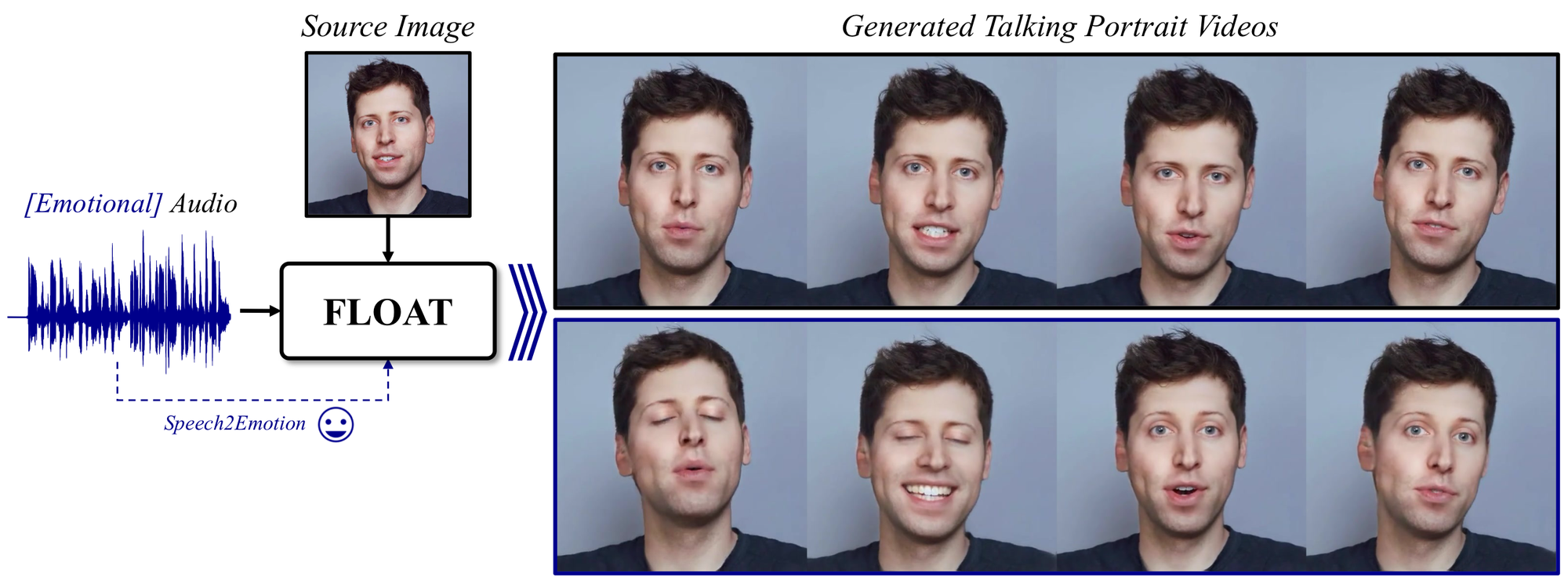
这篇论文的价值在于表示空间选择。它不是把更大的 diffusion backbone 堆到 talking head 上,而是把任务拆成“身份重建”和“动作生成”。这让它在速度上接近实时,也让 ablation 能比较清楚地回答:motion latent、Flow Matching、frame-wise conditioning 和 speech emotion 各自解决了什么。
Abstract
摘要把矛盾放在 diffusion portrait animation 的两个短板上:视频时序一致性和快速采样。diffusion-based 方法能生成高质量图像,但从噪声逐步反推视频通常要很多采样步;一旦每帧都要经过复杂生成器,几秒视频就可能变成分钟级推理。FLOAT 的问题意识是,talking portrait 不能只看单帧画质,还要看连续动作和推理延迟。
论文提出的方法是 flow matching based talking portrait generation。Flow Matching 不是像传统 diffusion 那样一步步预测噪声,而是学习一个把先验分布推到目标分布的 vector field,再通过 ODE solver 积分得到样本。对于 FLOAT,这个样本不是图像,而是一段 motion latent sequence。
摘要强调的 learned orthogonal motion latent space 是整篇文章的支点。它让模型把身份和动作拆开:identity latent 保存“这个人是谁”,motion latent 保存“这一帧怎么动”。orthogonal 结构则进一步带来可编辑性,因为 motion latent 可以投影到一组正交方向上,修改某个方向的系数通常更容易保持其它动作不乱。
transformer-based vector field predictor 负责在每个 flow time 上预测 motion latent 应该往哪里移动。论文特别说它有 frame-wise conditioning,因为 audio 条件天然是逐帧对齐的:嘴型和局部表情受附近音素影响,不能只用一个全局音频向量控制整段视频。
speech-driven emotion enhancement 是摘要最后的补充能力。它让音频里的情绪预测结果参与 motion sampling,使生成的人不只是嘴动,还能有情绪相关的头动和表情变化。这个 claim 后文主要通过 RAVDESS、emotion redirection、guidance scale ablation 和 user study 支撑,但情绪空间仍限制在七类基本标签。
Introduction
引言从 audio-driven talking portrait 的应用说起:avatar creation、video conferencing、virtual avatar chat、customer service。这里的应用不是泛泛背景,因为这些场景都强调实时交互和稳定身份。一个 talking portrait 只要嘴型准还不够,它还要有节奏性的 head movement、细粒度 facial expression,并且不能在视频中漂移。
论文随后指出 audio-to-motion 是 one-to-many。相同一句话可以配不同头动、眼神和表情;只凭音频并不能唯一决定面部动作。早期方法因此先集中在 lip movement 上,因为唇形与音素之间的关系最强,也最容易用 SyncNet 这类 audio-lip alignment loss 监督。
为了扩展动作范围,后续方法引入 VAE、normalizing flow 等概率模型,把 motion generation 变成采样问题。这一步承认了 one-to-many,但论文认为这些模型容量有限,生成动作的 expressive range 仍不够。也就是说,概率性有了,表达力还不够。
diffusion-based talking portrait 方法缓解了表达力问题。EMO 及其后续路线用 Stable Diffusion 这样的强图像先验,把 image diffusion 扩展到视频生成。论文对这条路线的批评集中在两点:采样效率低,几秒视频可能需要很长时间;辅助 facial prior 过重,比如 bounding boxes、2D landmarks、skeletons 或 3D meshes,会给头动和表情自由度带来空间偏置。
FLOAT 的回答是把生成空间换掉。Flow Matching 提供更快的采样路径,motion latent space 提供更贴近动作的目标分布,Transformer vector field predictor 提供时间建模能力。orthogonal basis 让生成后的 motion 可以被 test-time editing,speech-driven emotion 让动作不只追随音素,也能带上情绪。
三条贡献也围绕这条路线展开:用 learned orthogonal motion latent space 做 flow matching talking portrait;用 transformer-based vector field predictor 做 temporally consistent motion latent sampling,并支持 speech-driven emotion control;用实验说明它在 visual quality、motion fidelity 和效率上超过公开实现的 baseline。这里要注意,论文主张的是在它的公开 baseline 和协议下达到 SOTA,不等于对所有未公开系统或商业系统都成立。
Preliminaries
Flow Matching 的数学铺垫用一个时间相关变换 $\varphi_t$ 来描述生成过程。可以把它理解成:从一个容易采样的 prior distribution $p_0$ 出发,沿着时间 $t\in[0,1]$ 走到目标分布 $p_1$。推动这个过程的是 vector field $v_t$,它告诉样本在当前时间和位置应该往哪里移动。
直接学习真实 vector field 很难,因为真实 probability path 和目标 field 通常不可得。Conditional Flow Matching 的做法是给定一个真实样本 $x_1$,构造一条可训练的条件路径。FLOAT 使用的是 OT-based straight path:从噪声 $x_0$ 到数据 $x_1$ 走直线。
这样训练目标就变成让网络预测的 vector field 接近 $x_1-x_0$。在普通图像生成里,$x_1$ 可以是图像 latent;在 FLOAT 里,$x_1$ 是一段 motion latent sequence。这个选择直接决定了模型只学习“动作轨迹怎么从噪声变出来”。
论文还引入 classifier-free vector field,用 guidance scale 调整条件强度。它和 diffusion 里的 classifier-free guidance 思路相近,只是操作对象从噪声预测换成 vector field。FLOAT 后面把它扩展成 incremental CFV,分别调 audio guidance 和 emotion guidance。
Method
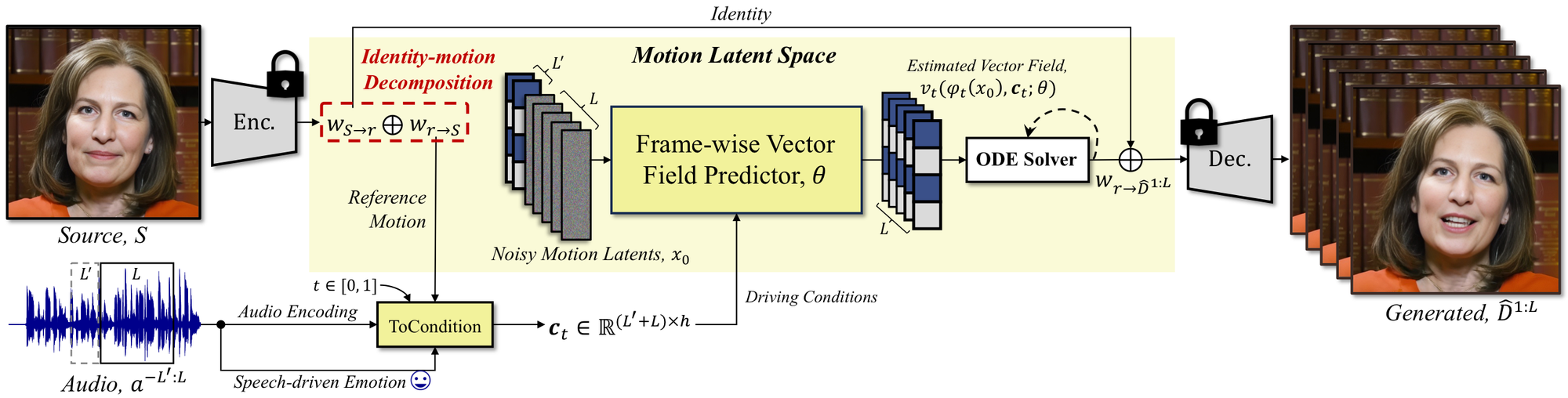
方法总览给出输入输出:source image $S\in\mathbb{R}^{3\times H\times W}$,driving audio feature sequence $a^{1:L}\in\mathbb{R}^{L\times d_a}$,输出是 $L$ 帧 video $\hat{D}^{1:L}\in\mathbb{R}^{L\times3\times H\times W}$。这里的“audio feature”已经不是原始波形,而是由 Wav2Vec2.0 这类音频编码器抽出的逐帧表示。
Phase 1 训练 motion latent auto-encoder。论文不使用 Stable Diffusion 的 VAE latent,因为图像 VAE 更擅长压缩外观和语义,不天然对应头动、嘴型和眼动。FLOAT 采用 LIA 风格的 latent image animation 表示,把图像编码成 identity latent 和 motion latent 的和:
其中 $w_{S\to r}$ 表示把 source 身份映射到 canonical reference 的身份信息,$w_{r\to S}$ 表示从 reference 到 source 当前姿态/表情的动作信息。motion latent 进一步写成正交基组合:
这个公式是后文 $\lambda$-control 的来源。因为 $\mathbf{v}_m$ 是 learned orthonormal basis,某个 motion latent 可以通过内积投影得到系数 $\lambda_m$。测试时改这些系数,就能做一定程度的头部姿态编辑。
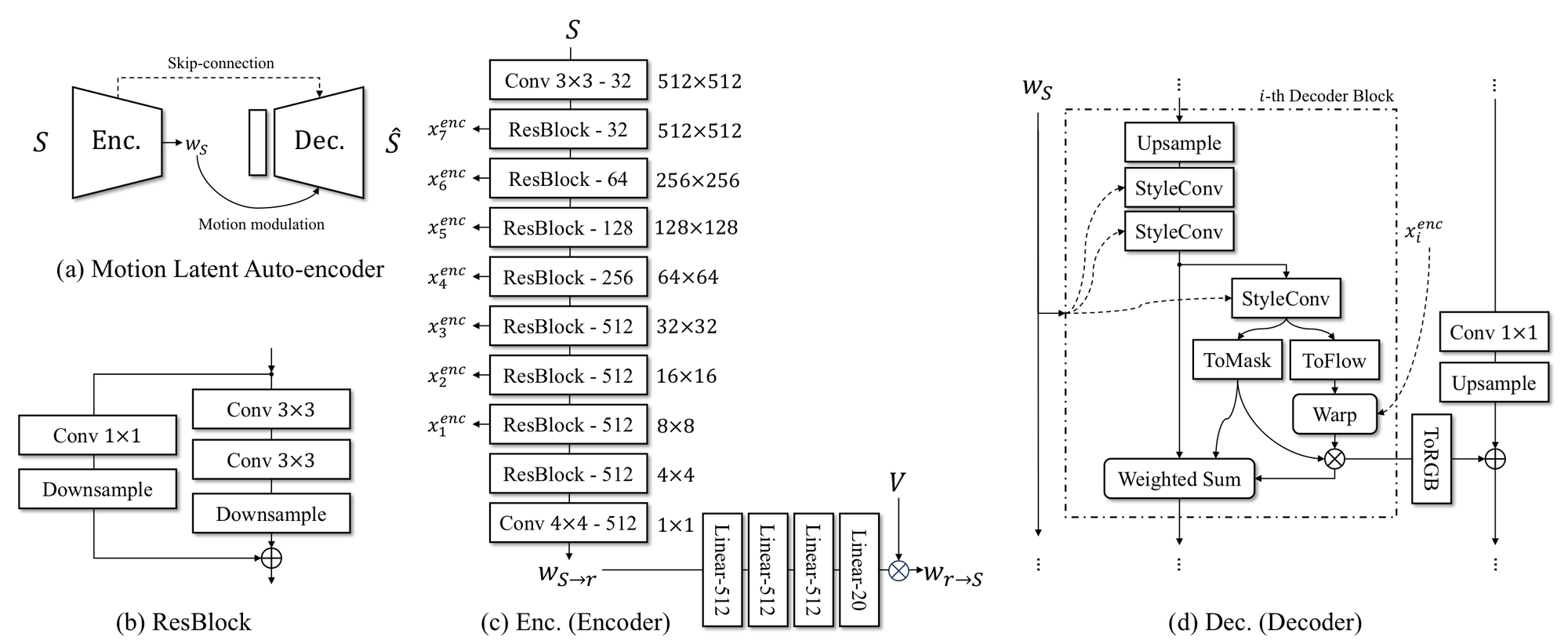
训练 auto-encoder 时,source image 和 driving image 来自同一个 video clip。模型用 source 的 identity 加 driving 的 motion 去重建 driving frame。这个训练方式迫使 encoder 不要把身份和动作混在一起,否则它无法把同一个人的不同帧重组出来。
论文还提出 facial component perceptual loss。高分辨率 talking face 里,嘴、牙齿、眼球和眉眼动作很容易被全图 loss 忽略,因为大面积皮肤和背景占了更多像素。FLOAT 用 VGG-19 multi-scale feature pyramid,并对 mouth / eye mask 区域单独计算 perceptual loss,让小区域的结构变化也被训练信号看见。
这个 loss 的解释很细:在 face restoration 里,眼睛和牙齿通常被看成 texture fidelity 问题;但在 motion auto-encoder 里,source 和 target 存在空间错位,问题更像结构对齐。因此只靠局部 texture discriminator 不够,component perceptual supervision 更直接。
Phase 2 在 motion latent space 里做 Flow Matching。网络预测 $v_t(x_t,\mathbf{c}_t;\theta)\in\mathbb{R}^{L\times d}$,也就是每一帧 motion latent 在 flow time $t$ 上的速度。$x_t$ 是 noisy motion latent,$\mathbf{c}_t$ 是 driving condition。ODE solver 沿着 vector field 积分,得到生成的 motion latent sequence。
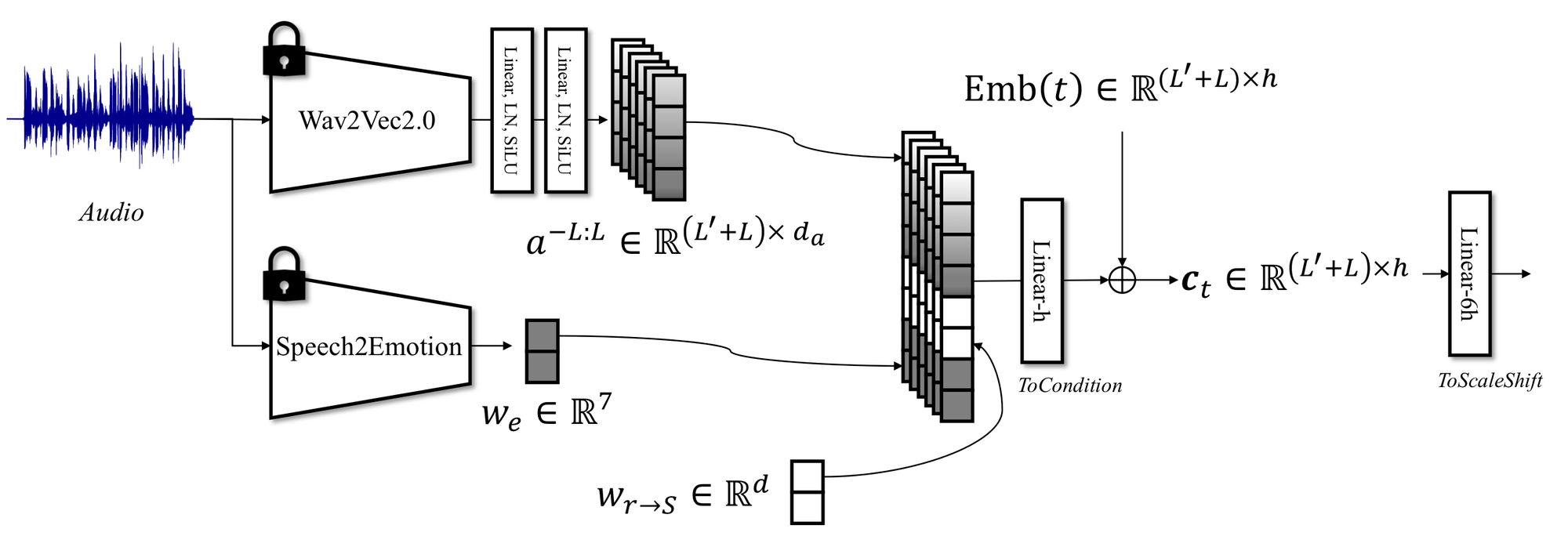
speech-driven emotion enhancement 解决的是“动作不只是音素”的问题。悲伤的声音可能伴随低头、避开视线或较小的动作幅度;兴奋或惊讶的声音可能带来更大的眉眼和头动。FLOAT 使用预训练 speech emotion predictor 输出 angry、disgust、fear、happy、neutral、sad、surprise 七类 softmax probability,再把它送入 vector field predictor。
论文同时承认,音频情绪并不总是清晰单一。人说话可能混合情绪,speech emotion classifier 也可能不准。FLOAT 的处理方式是训练时把 emotion 与其它 driving conditions 一起注入,推理时允许用户改 emotion label 或调整 guidance scale。这让它有 emotion redirection 能力,但也意味着情绪控制依赖分类器和七类标签空间。
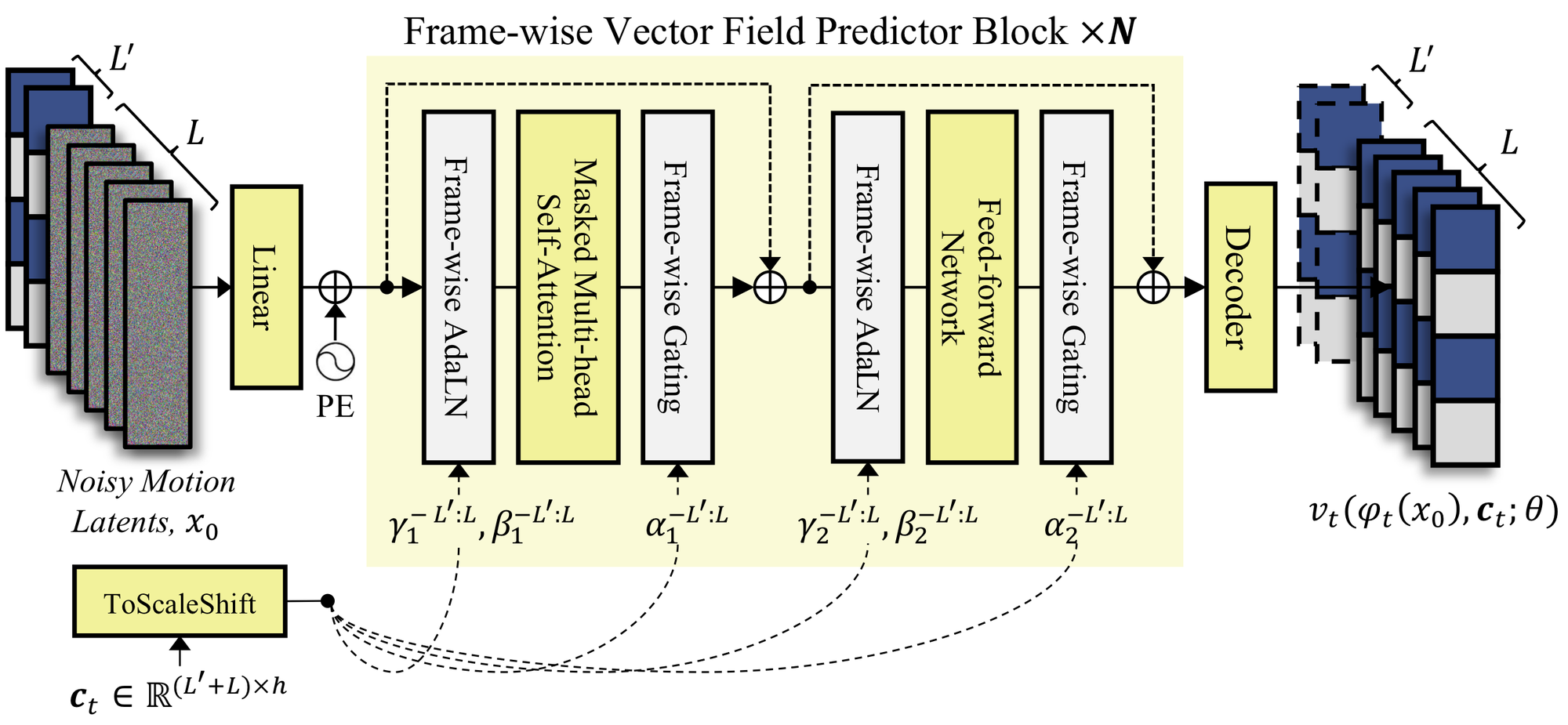
DiT 通常用同一个 timestep embedding 和 class embedding 调制所有 token;FLOAT 改成每个 frame latent 使用对应的 frame condition。原因很直接:第 $l$ 帧的嘴型和表情主要受附近 audio feature 影响。后续 masked self-attention 只看 $2T$ 个邻近帧,论文设置 $T=2$,这给了局部时间一致性,同时避免所有帧无限制互相干扰。
训练时,目标 motion latent sequence $w_{r\to D^{1:L}}$ 来自真实 driving frames。模型用 OT path 构造 noisy input,并学习目标速度 field。长视频按 window 生成,为了避免 chunk 之间断裂,输入还包含 preceding $L'$ frames 的 audio feature 和 motion latents。论文默认 $L=50$、$L'=10$,25 FPS 下大约覆盖 2.4 秒上下文。
$\mathcal{L}_{vel}$ 约束相邻帧的一阶差分,目的是减少 motion latent 的突变。训练中还对 reference motion、emotion 和 audio 条件做 dropout,用于 classifier-free vector field;对 preceding audio / motion 做更高概率 dropout,让模型能处理初始 window 没有历史上下文的情况。
推理时,FLOAT 从 Gaussian noise 出发,用 audio、emotion、reference motion 和历史上下文作为条件积分出 motion latent。论文使用 Euler solver,默认约 10 NFE。最后把 source identity latent 加到 generated motion latent 上,用 decoder 输出视频帧,再把原始音频 mux 回视频。
Experiments
实验数据分两阶段。motion latent auto-encoder 使用 HDTF、RAVDESS 和 VFHQ;训练 FLOAT 本体时排除 VFHQ,因为 VFHQ 没有同步音频。HDTF 提供 high-definition talking face,RAVDESS 提供情绪强的视频,VFHQ 补充身份多样性。这解释了为什么 Phase 1 更重重建和身份/动作空间,Phase 2 更重 audio-synchronized motion。
预处理统一到 25 FPS,音频重采样到 16 kHz,人脸区域裁剪并 resize 到 $512^2$。HDTF 训练使用 11.3 小时、240 个 videos、230 个 identities,测试使用 78 个 disjoint identities,每段 15 秒。RAVDESS 使用 22 个 identities 训练,剩余 2 个 identities 测试。训练和测试 identity disjoint,因此评估不是同身份重建,而是 unseen identity 条件下的生成。
实现细节给得比较完整。motion latent dimension 是 $d=512$,orthogonal directions 是 $M=20$;vector predictor 使用 8 attention heads、hidden dimension $h=1024$、attention window length $T=2$;batch size 8,learning rate $10^{-5}$,Adam,$\lambda_{OT}=\lambda_{vel}=1$,Phase 2 在单张 A100 上训练约 2 天、2000k steps。supplement 还给出 auto-encoder 约 460k steps、9 天、单张 A100,learning rate $2\cdot10^{-4}$。
指标覆盖画质、视频分布、身份、表情、姿态和音画同步。FID / FVD 看生成图像和视频分布,CSIM 看 identity embedding cosine similarity,E-FID 和 P-FID 分别看 3DMM expression / pose distribution,LSE-D / LSE-C 用 Wav2Lip / SyncNet 风格指标评估 lip synchronization。这个指标组合比只报 PSNR/SSIM 更适合 talking portrait,因为它关注动作和同步。
baseline 分成 non-diffusion 和 diffusion 两类。SadTalker、EDTalk 是非 diffusion 方法;AniTalker、Hallo、EchoMimic 是 diffusion-based 方法。论文只比较官方实现公开的方法;EMO 和 VASA-1 因实现不可用,只在 supplement 里用 demo videos 做额外视频比较。这个边界很重要:主表的公平性来自可运行实现,但也无法覆盖未公开强系统。
| Method | FID↓ | FVD↓ | CSIM↑ | E-FID↓ | P-FID↓ | LSE-D↓ | LSE-C↑ |
|---|---|---|---|---|---|---|---|
| Hallo | 25.363 / 57.648 | 197.196 / 375.557 | 0.869 / 0.860 | 1.039 / 2.492 | 0.037 / 0.050 | 7.792 / 7.613 | 7.582 / 4.795 |
| EchoMimic | 33.552 / 81.839 | 296.757 / 320.220 | 0.823 / 0.805 | 1.234 / 3.201 | 0.023 / 0.047 | 8.903 / 8.161 | 6.242 / 4.144 |
| FLOAT | 21.100 / 31.681 | 162.052 / 166.359 | 0.843 / 0.810 | 1.229 / 1.367 | 0.032 / 0.031 | 7.290 / 6.994 | 8.222 / 5.730 |
主表的读法要克制。FLOAT 在 FID、FVD、E-FID、P-FID、LSE-D、LSE-C 上整体很强,说明画面分布、视频分布、表情/姿态和 lip-sync 都受益于 motion latent flow。CSIM 不是第一,Hallo 更高,所以不能把结果解读成 FLOAT 在身份保持上全面压过所有方法。它的优势更集中在运动质量、同步和速度。
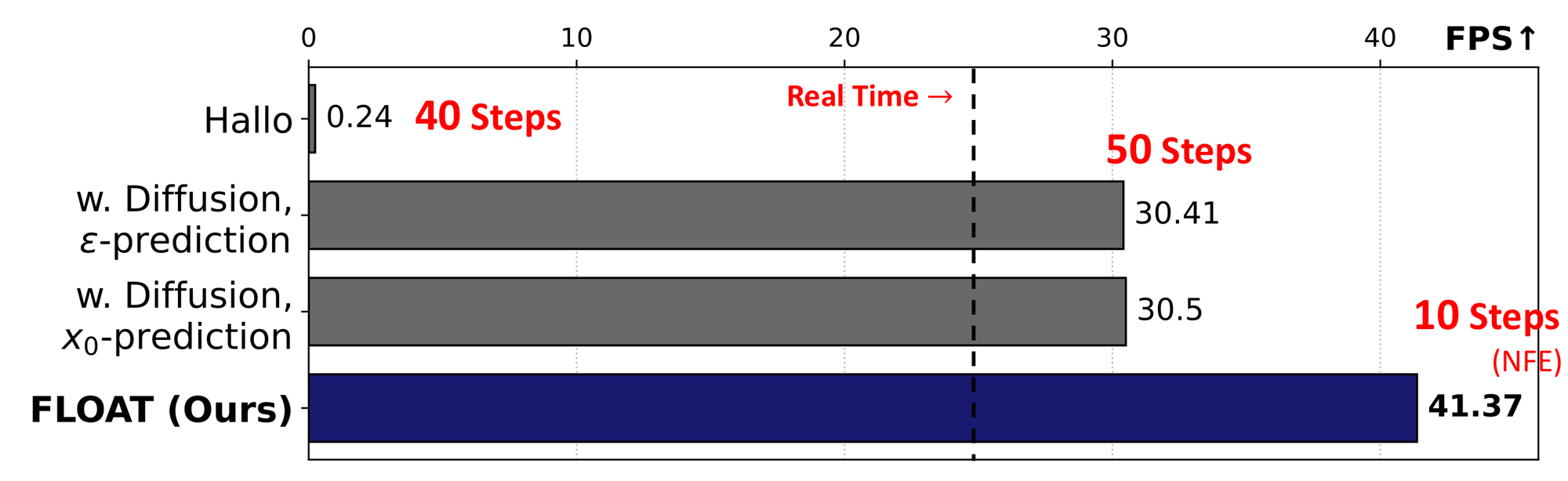
NFE ablation 说明速度不是越少步越好。supplement 报告 NFE 2 仍有不错 FID 和 LSE-D,但 FVD 和 E-FID 变差,表现为头动不稳定、表情静态或过强。原因是图像质量主要由 auto-encoder 决定,而 motion consistency 需要足够积分步数。默认 NFE 10 是画质、口型和动作稳定之间的折中。
application 部分展示 $\lambda$-control。因为 learned basis 是 orthonormal,生成出的 motion latent 可以通过内积得到某个 basis coefficient:
这使测试时 pose editing 成为可能:改某个 $\lambda_k$,再把 motion latent 组合回去。论文例子是调整 head direction,而且声称不会明显干扰其它动作。这个能力来自 motion representation 的结构,而不是额外训练一个 pose controller。
emotion redirection 则更偏控制接口。若 speech emotion predictor 对音频情绪判断模糊,用户可以把 emotion label 改成指定 one-hot,并通过 emotion guidance scale 增强。GitHub README 也保留了 --emo 和 --e_cfg_scale,并建议更强情绪可尝试 5 到 10 的 scale。这里要保留工程边界:大 scale 是调参,不保证所有输入都自然。
frame-wise AdaLN 和 Flow Matching 消融对应两条设计主张。frame-wise AdaLN 相比 cross-attention 有更好的 expression generation 和 lip synchronization,说明“每帧条件先调制,再建模时间关系”是有效的。Flow Matching 与两个 diffusion parameterization 相比,在相近图像质量下 lip synchronization 更好,并且 NFE 更少。这个证据支撑了论文的速度和同步 claim。
user study 使用 15 名参与者,对 6 个方法生成的视频按 lip sync accuracy、natural head motion、teeth clarity、natural emotion 和 overall visual quality 打分。FLOAT 在五项中均最高,例如 lip sync 3.93、teeth clarity 4.13、overall 3.87。主观实验加强了 qualitative claim,但样本规模不大,仍应看作补充证据。
Limitation, Discussion, Conclusion
论文的结论把贡献压回同一条主线:FLOAT 利用 learned motion latent space 做 flow matching talking portrait,transformer vector field predictor 负责 temporally consistent motion generation,speech-driven emotion labels 提升动作自然度。它要解决的 core limitation 是 diffusion-based talking portrait 的慢采样,同时尽量保持画质和动作质量。
supplement 的 ethical consideration 很直接:单图加音频即可生成逼真 talking portrait,存在 deepfake 滥用风险。作者提到 watermark 和 carefully restricted license 作为缓解方式。这个说法和 GitHub 当前 license 一致:代码和 checkpoint 是非商业、不可改作分发的 CC BY-NC-ND 4.0。
资源状态对复现影响很大。GitHub 当前公开了 inference code、checkpoint 下载脚本和示例命令,但 README 明确说明 repository 是 one-time code drop,只有 inference code,training code will not be released。因此可以做推理验证、集成试用和局部工程分析,但不能完整复现实验训练曲线、消融训练和数据处理细节。
情绪建模的限制来自七类 basic emotion label。论文自己指出,FLOAT 不能表达更细腻的情绪状态,比如 shyness。这不是简单的数据集缺口,也和条件形式有关:speech-to-emotion soft label 是粗粒度分类信号,不是开放文本或连续 affect representation。作者把 textual cues 作为未来方向,是合理的延伸。
数据分布也有明确偏置。FLOAT 主要依赖 open-source high-definition face datasets,HDTF / RAVDESS 的 head pose 分布偏 frontal,因此对非正脸,特别是 $|\mathrm{yaw}|\geq20^\circ$,以及眼镜等 accessories,会出现退化。README 也提醒非正脸图像和自动 crop / padding 会影响结果。
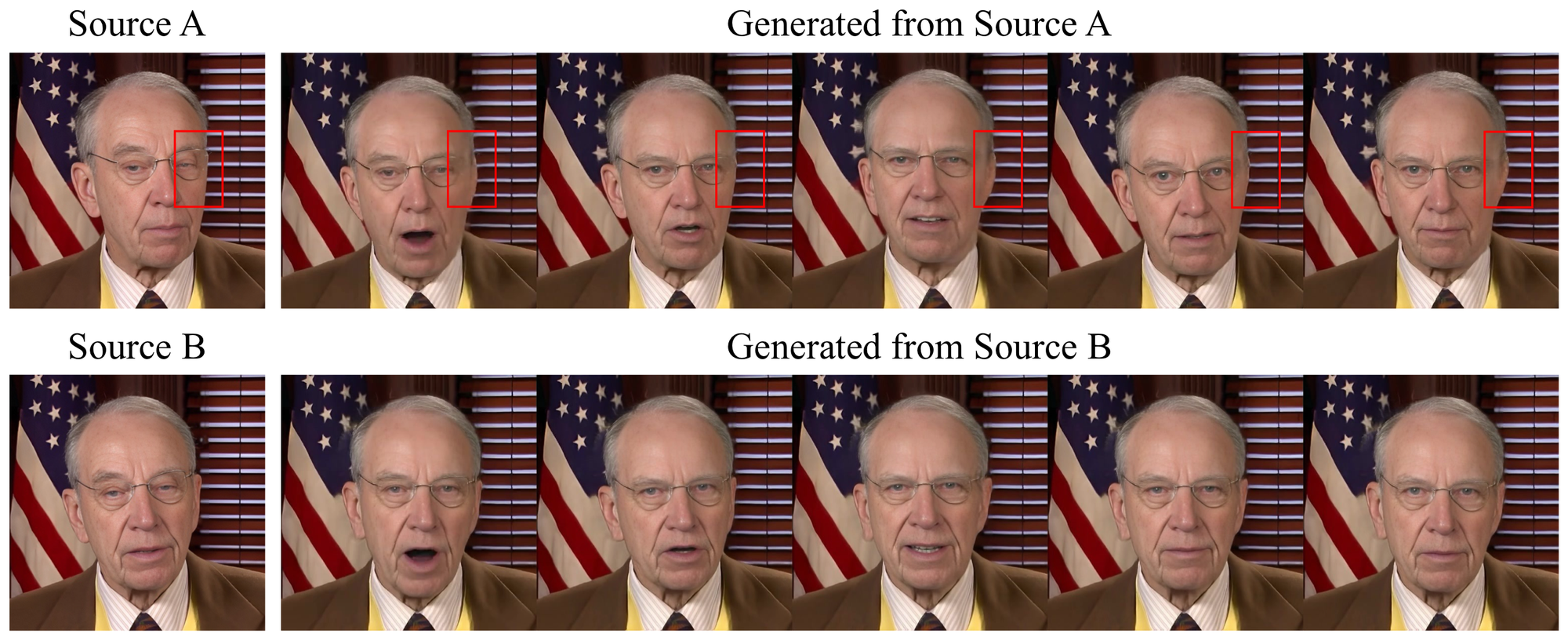
对工程使用来说,音频质量也是关键变量。README 建议背景音乐重时先做 vocal extraction,说明 Wav2Vec2 feature 和 speech emotion recognizer 都会受噪声、混响、多说话人和音乐影响。FLOAT 的论文指标是在清洗后的 benchmark setting 下取得的,真实输入需要额外音频预处理。
概念补充与参考阅读
Flow Matching / Conditional Flow Matching
Flow Matching 学的是把噪声分布推到数据分布的 vector field。FLOAT 把目标数据换成 motion latent sequence,因此 ODE solver 积分出来的是“怎么动”,不是直接生成图像。
Rectified Flow / OT Straight Path
OT-based path 用直线连接 $x_0$ 和 $x_1$,目标速度是 $x_1-x_0$。这让 FLOAT 可以用较少 NFE 得到合理 motion latent,但过低 NFE 会先伤害运动稳定性。
参考阅读:Rectified Flow
LIA / Motion Latent
LIA 的思想是把图像动画表示成 latent space navigation。FLOAT 借用这种 identity-motion decomposition,并进一步用 orthonormal basis 让 motion latent 可以投影、编辑和重组。
Frame-wise AdaLN
AdaLN 用条件向量调制 LayerNorm 的 scale 和 shift。FLOAT 的重点是 frame-wise:每帧 motion token 用对应帧的 audio/emotion/reference condition 调制,再通过 masked self-attention 建模邻近时间关系。
参考阅读:DiT
Wav2Vec2 / Speech2Emotion
Wav2Vec2 提供逐帧语音表示,主要服务嘴型、节奏和音素相关动作;Speech2Emotion 输出七类情绪概率,服务非语言表情和头动增强。FLOAT 的 emotion control 依赖这两个音频侧条件的稳定性。
NFE / Euler ODE Solver
NFE 是 number of function evaluations,也就是采样时调用 vector field predictor 的次数。FLOAT 默认 NFE 10,用 Euler solver 积分;NFE 越低越快,但 motion consistency 和 emotion expressiveness 会更容易受损。
FID / FVD / CSIM / LSE
FID 看图像分布,FVD 看视频分布,CSIM 看身份 embedding 相似度,LSE-D / LSE-C 看音画同步。FLOAT 的主表优势主要在 FID、FVD、E-FID、P-FID 和 LSE,不应被概括成所有指标全面第一。
HDTF / RAVDESS / VFHQ
HDTF 提供高分辨率 talking face,RAVDESS 提供情绪强的视频,VFHQ 提供更多身份和高清人脸视频。FLOAT 用 VFHQ 训练 auto-encoder,但训练 audio-synchronized Flow Matching 时排除 VFHQ,因为它没有同步音频。
参考阅读:HDTF paper / RAVDESS / VFHQ
总结
一句话总结:FLOAT 把 talking portrait 的生成目标从完整视频换成 motion latent trajectory,再用 Flow Matching 快速采样这条轨迹,最后由 identity-motion decoder 合成视频。
一句话评价:这是一篇表示空间选择很清楚的 talking portrait 论文,研究价值在 motion latent + flow 的任务分解,工程使用则受限于训练代码不公开、非商业许可、正脸数据偏置和粗粒度情绪标签。
对研究阅读来说,它最值得借鉴的是“先问应该生成什么”。如果任务本质是动作生成,就不一定要在像素或图像语义 latent 里生成全部内容。对工程落地来说,FLOAT 更适合作为推理型 baseline 和 motion-latent 架构参考;要把它做成稳定产品,还需要更鲁棒的数据覆盖、音频预处理、非正脸处理、细粒度情绪控制和明确授权。
Recommended citation: Ki, Min, and Chae. FLOAT: Generative Motion Latent Flow Matching for Audio-driven Talking Portrait. ICCV 2025.
Download Paper